Why Indian Degrees Are Losing Global Value (And How to Fix It) | Classroom365
Indian degrees are losing global recognition due to skill gaps and outdated systems. Learn the real reasons and practical solutions to fix it in 2026.
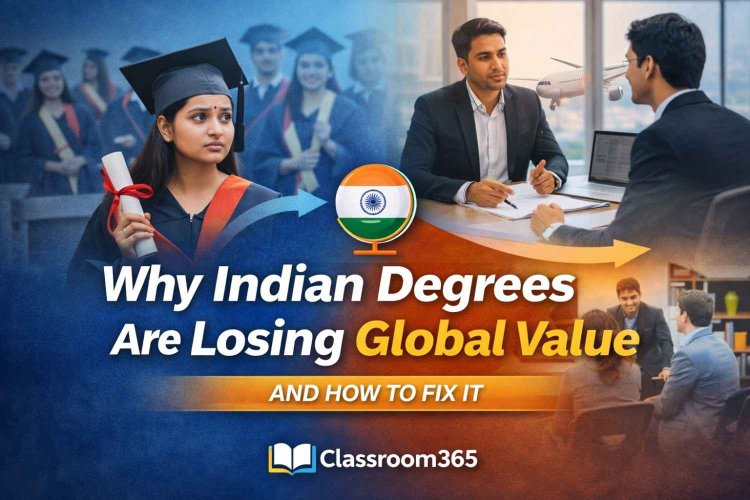
The Growing Concern Parents Can’t Ignore
For decades, an Indian degree was considered a powerful ticket to stability and respect. Engineering, medicine, management, and government jobs defined success.
But in 2026, a difficult question is emerging:
Are Indian degrees losing their global value?
Many graduates struggle to compete internationally. Employers increasingly prioritise skills, portfolios, and adaptability over university names alone. Students pursuing higher education abroad often discover that their degrees do not carry the same weight outside India.
This is not about blaming institutions — it’s about understanding reality and fixing it.
The Global Education Shift: What Changed?
Higher education worldwide is evolving rapidly.
According to the World Economic Forum, the future workforce will be defined by critical thinking, problem-solving, digital literacy, and adaptability — not just academic qualifications.
???? https://www.weforum.org/reports/the-future-of-jobs-report-2023/
Similarly, global employability rankings show increasing emphasis on skill-based assessment rather than traditional academic scoring systems.
The world is moving from:
Degree-based hiring → Skill-based hiring
And that is where many Indian graduates face challenges.
Why Indian Degrees Are Losing Global Value
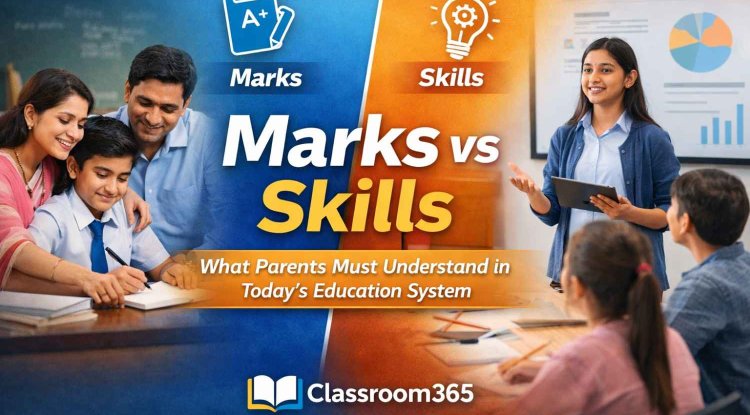
1️⃣ Overemphasis on Marks Over Skills
The Indian education system still prioritises:
-
Theoretical learning
-
Exam performance
-
Cut-off-based filtering
But global employers look for:
-
Practical exposure
-
Project experience
-
Communication skills
-
Real-world problem solving
This gap reduces international competitiveness.
???? Related read:
???? https://blog.classroom365.in/marks-vs-skills-what-parents-must-understand
2️⃣ Outdated Curriculum in Many Institutions
While India has world-class institutes like the IITs and IIMs, many colleges still operate with outdated syllabi that do not match global industry trends.
Emerging sectors such as:
-
Artificial Intelligence
-
Data Science
-
Climate Technology
-
Cybersecurity
-
Global Digital Commerce
require continuous curriculum updates.
The Organisation for Economic Co-operation and Development highlights the importance of aligning education systems with labour market needs.
???? https://www.oecd.org/education/
3️⃣ Limited Research & Innovation Ecosystem
Global university rankings value:
-
Research output
-
Patents
-
Industry collaboration
-
International faculty exchange
According to the QS World University Rankings, research impact and global employer reputation strongly influence rankings.
???? https://www.topuniversities.com/
India produces strong talent — but research funding and global collaborations still need strengthening.
4️⃣ Global Perception & Brand Gap
Universities in the US, UK, Germany, and Australia have built global brand credibility over decades.
Indian universities — except a few elite institutions — still lack:
-
Strong international alumni visibility
-
Global employer trust
-
Consistent academic benchmarking
This perception gap affects the degree value internationally.
5️⃣ Skill Gap Identified by Employers
Multiple industry reports suggest a significant employability gap among graduates.
The All India Council for Technical Education has acknowledged the need for industry-aligned reforms and the integration of skills in higher education.
???? https://www.aicte-india.org/
This is not a talent issue — it is a training alignment issue.
The Real Impact on Students
When degrees lose global weight:
-
Students pursue expensive foreign master’s degrees for validation
-
Employers prioritise certifications over university names
-
Salary growth slows for skill-deficient graduates
-
Brain drain increases
Parents often invest lakhs in education — but ROI depends on employability, not just graduation.
How to Fix It: The Way Forward
The solution is not abandoning degrees.
The solution is upgrading them.
1️⃣ Shift from Degree-Centric to Skill-Integrated Education
Colleges must embed:
-
Industry projects
-
Internships
-
Real-world simulations
-
Communication training
???? Related read:
???? https://blog.classroom365.in/skill-based-education-vs-traditional-education/
Degrees should certify competence, not just attendance.
2️⃣ Stronger Industry-Academia Collaboration
Indian institutions must:
-
Partner with startups & corporates
-
Introduce live case studies
-
Encourage mentorship programs
-
Promote entrepreneurship cells
Global systems thrive because industry and academia operate together.
3️⃣ Encourage Research & Innovation Culture
India must increase:
-
Research grants
-
International faculty exchanges
-
Patent incentives
-
University incubators
Global value grows when institutions create knowledge — not just distribute it.
4️⃣ Improve Communication & Soft Skills
Many Indian graduates struggle not due to lack of knowledge, but due to:
-
Low confidence
-
Weak global communication exposure
-
Limited cross-cultural interaction
Soft skills are no longer optional — they are career multipliers.
5️⃣ Career Counselling at the School Level
The problem begins early.
Students often choose degrees based on:
-
Social pressure
-
Parental expectations
-
Cut-off marks
Instead, career guidance must help students align:
-
Aptitude
-
Interest
-
Market demand
UNESCO emphasises future-ready education systems that prepare learners for evolving economies.
What Parents Must Understand
A degree is still important.
But it is no longer enough on its own.
In today’s global economy:
???? Degree = Foundation
???? Skills = Differentiator
???? Exposure = Multiplier
Parents must focus on building capability, confidence, and competence — not just collecting certificates.
Final Thoughts: Indian Degrees Are Not Weak — They Need Evolution
India has some of the brightest minds in the world. The challenge is not intelligence — it is system alignment.
If institutions modernise curriculum, embed skills, strengthen research, and collaborate globally, Indian degrees can regain — and even surpass — global credibility.
The future will not belong to degree-holders alone.
It will belong to problem-solvers, innovators, and adaptable learners.
And the transformation begins with awareness.
— Classroom365
What's Your Reaction?